For the complete documentation index, see llms.txt. This page is also available as Markdown.

📆Day In the Life of a vCon

The easiest way to understand a conserver is to follow one conversation through it. This page does that. A customer calls a car dealership's service line, and we watch the record of that call travel from the phone system to an AI assistant answering a manager's question about it a week later, picking up a transcript, a summary, a tag, a CRM record and two signed receipts on the way.

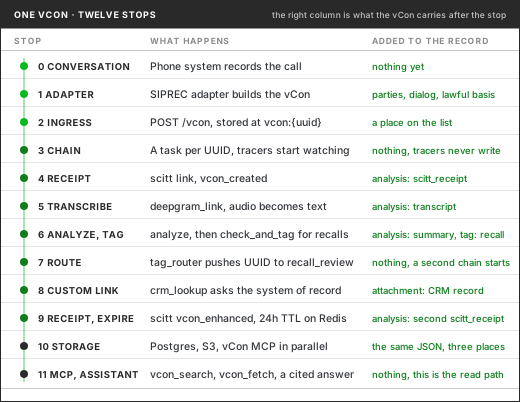
The same trip is drawn as a conveyor belt in The Journey of a vCon. The station names below match that picture, so you can read the two side by side.

For the example, assume a conserver is running with one chain configured for the service line. The chain records the vCon on a transparency ledger, transcribes it, summarizes it, checks whether the customer mentioned a safety recall, routes the ones that did to the service team, looks the caller up in the CRM, and stores the finished record in Postgres, S3 and the vCon MCP server. Every step is a configuration choice. None of it is code the dealership wrote.

The stations one vCon passes through, from the phone system to an AI assistant
One conversation, twelve stops. The adapter builds the vCon, the chain grows it, storage keeps it, the MCP server answers questions about it.

0. The conversation

A customer calls the dealership about a noise from the front of her car. The service advisor answers. The call is recorded, and the recording announcement at the start of the call tells her so. Nothing about this is special yet. The phone system holds an audio file and some SIP signaling, in whatever format the phone system prefers, and if nothing else happened that is where the conversation would stay.

1. The adapter

The phone system forks the call to a SIPREC recording server, and a SIPREC adapter is listening there. When the call ends, the adapter builds the vCon.

It creates a parties[] entry for the customer and one for the advisor, each carrying the SIP address, contact and display name that the signaling revealed. It creates a dialog[] entry of type recording that points at the audio by URL and carries a SHA-512 hash of the file, so the recording can live in object storage while the vCon stays small. It files the raw INVITE, the SDP and the STIR/SHAKEN PASSporT as attachments, each marked with a purpose such as sip-invite or stir-passport-extended, and declares sip-signaling in extensions[].

Then it adds the attachment that governs everything downstream: a lawful_basis record. The basis is consent, the proof mechanism is the recording announcement at dialog_index 0, the purpose_grants[] say what the dealership may do with this conversation (recording, transcription and analysis, each granted: true) and there is an expiration date. The permission now travels with the conversation instead of sitting in a policy document.

The adapter assigns the vCon a v4 UUID. That UUID is the conversation's name for the rest of its life. Adapters are source specific. Nine are published in vcon-dev today, for Twilio, SignalWire, SIPREC, Sippy, ElevenLabs, audio file drops, laptop capture, AI agent sessions and an MCP session proxy, plus a template for writing your own. Each speaks one platform's dialect and emits the same container. See vCon Adapters.

2. Onto the belt

The adapter posts the vCon to the conserver:

The conserver stores the JSON in Redis under the key vcon:{uuid} and pushes the UUID onto the service_calls list. An external partner with a scoped key can do the same through POST /vcon/ingress, which takes a list of UUIDs for vCons already in Redis and can write only to the list its key is scoped to.

From here the vCon is never passed between processes. Every link reads it from Redis and writes it back to Redis, which matters when the dialog holds an hour of audio. The list is durable buffering. If ten thousand calls end at five o'clock, the list absorbs them and workers pull at their own pace. See API.

3. The chain

On its next tick the conserver reads the service_calls list, finds the new UUID and creates a task for it. The chain configured on that list is an ordered set of links, written in YAML:

Each link takes the UUID, does one thing to the vCon, and returns the UUID to continue or nothing to stop. Because links take and return the same thing, order is a configuration choice and so is vendor. Change the YAML, POST /config, and the next vCon takes the new route. No redeploy.

Before the first link runs, the chain's tracers fire once with a link index of -1 to record the starting state. A tracer watches. It never writes to the vCon. The documented one is the JLINC tracer, which signs a record of each transition, hashes the vCon as it stood, and files the result in an external archive. It fires again after every link and once more when the chain completes. See Conserver Tracers.

4. The first receipt

The first link is scitt, configured with vcon_operation: vcon_created. It signs a statement about the vCon with the conserver's key, registers it on a SCITT transparency service, and gets back a COSE receipt. With store_receipt: true the receipt is written into the vCon as an analysis[] entry of type scitt_receipt, carrying the ledger entry_id, the cose_receipt and the statement's subject.

That is the first entry in the conversation's lifecycle. Anyone holding the vCon later can prove it existed at this moment and has not been altered since, without trusting whoever stored it. See the Lifecycle extension.

5. Transcription

The second link is deepgram_link. It reads the recording from the dialog, skips it if the audio is shorter than minimum_duration, sends it to Deepgram's nova-2 model with language detection on, and writes the result into analysis[]: the full text, timed segments and confidence scores, with vendor and product recorded so a reader knows what produced it.

Audio is opaque. Text is searchable, summarizable, redactable and auditable. This is the moment the conversation becomes data.

Swapping the vendor is an edit to the YAML. groq_whisper, hugging_face_whisper, openai_transcribe and the local transcribe link all write the same kind of entry, and wtf_transcribe writes the WTF transcription format through the vfun service. If the vCon already carries a transcript the link notices and skips the work, which is what makes reprocessing a chain cheap.

6. Analysis and tagging

The third link is analyze, with a summary prompt. It reads the transcript out of analysis[], sends it to the configured model, and writes a summary analysis back. Customer reports a grinding noise from the front wheels at low speed, about 30,000 miles, advisor booked an inspection for Thursday.

The fourth link is check_and_tag, configured with the evaluation_question "Does the customer mention a safety recall or a recall notice they received?" and a tag of recall: true. The model reads the transcript, answers yes, since the customer said she had a recall letter in the glove box and wondered whether it was related, and the link writes the tag into the vCon's tags attachment. If the answer had been no, the link would have added nothing and the chain would have carried on.

This is the old "recall finder" from the first version of this page, done without writing a link. Every question the business wants asked of every call is one check_and_tag entry in the YAML.

7. Routing

The fifth link is tag_router, with a route that maps the recall tag to a Redis list called recall_review and forward_original: true. It pushes the UUID onto recall_review and returns it, so the main chain continues. The conversation is now on two belts at once.

A second chain reads recall_review. In this deployment it has one link, webhook, which POSTs the whole vCon to the service scheduler's intake endpoint so the recall gets checked while the car is in for the noise. It could as easily have been post_analysis_to_slack with a template built from the summary, or a jq_link filtering for a particular model year. A chain's egress list is another chain's ingress list, and that is how long processes are built out of short ones.

The sixth link is the dealership's own. crm_lookup is forty lines of Python following the custom link template. It reads the customer's number from parties[], asks the CRM what it knows, and writes the answer back as an attachment carrying the account number, the vehicle's VIN, the open repair order and the customer's assigned advisor, with the party index that says who it refers to.

Three moves: read an identifier from the vCon, ask the system that owns it, write what comes back into the vCon. The next link, the storage layer, and the manager's assistant a week from now all read the CRM answer out of the record rather than asking the CRM again. One lookup, many readers.

9. The second receipt and the cleanup

The seventh link is scitt again, this time with vcon_operation: vcon_enhanced. The vCon has grown by a transcript, a summary, a tag and a CRM record since the first receipt, and this signs the new state. Two receipts in analysis[] now bracket the chain's work.

The last link is expire_vcon, which sets a 24 hour TTL on the Redis key. The working copy in Redis is a cache, and this is how it is kept from growing without bound. The record itself is about to land somewhere permanent.

10. Storage

The chain is finished, so the conserver writes the vCon to every storage configured on it, in parallel by default. postgres writes a row to the vcons table with the full document in a JSONB column, the subject and the timestamps. s3 writes the file to {path}/2026/09/02/{uuid}.vcon by creation date. vcon_mcp POSTs the vCon to a running vCon MCP server's REST API, which puts it in the Supabase database that AI assistants will read from.

Then the UUID is pushed onto the service_done egress list for anything that wants to run next. Fourteen storage backends ship with the conserver, from Elasticsearch and Milvus to Microsoft Dataverse and a SCITT storage that registers the finished vCon on the ledger without writing the receipt back. One write, many destinations, each tuned to a different reader. See Storage.

Had any link thrown an exception, or the chain run past its 600 second timeout, the UUID would have gone to service_calls:dlq instead, where it waits seven days for someone to inspect it and POST /dlq/reprocess sends it back through. Nothing is dropped silently.

11. The MCP server

The conserver's work is done. It processed the conversation once, on arrival, whether or not anyone ever asks about it. Asking is the vCon MCP server's job.

The MCP server is the read path over the same store. It exposes 37 tools over the Model Context Protocol, so an AI assistant can search conversations by metadata, by keyword, by meaning, or by a hybrid of the two, then fetch one record or one component of one. It reads Redis first and falls back to Postgres, so a conversation someone looked at a moment ago comes back in a couple of milliseconds. Nothing is copied between the two systems. The conserver decides what the record becomes. The MCP server decides what can be asked of it. See MCP and Conserver Together.

12. The assistant

A week later the service manager asks her assistant, in plain English, which customers mentioned a recall in the last seven days and whether each one has a repair order open.

The assistant calls vcon_search with the recall tag and a date range, gets a page of results with our vCon among them, and calls vcon_fetch on it asking for summary, parties and attachments. The summary tells it what the call was about. The CRM attachment tells it the repair order number and the advisor. The lawful basis attachment tells it that analysis was granted, so the answer it is about to give is one it was allowed to compute. It answers with the customer's name, the Thursday appointment, the open repair order and a citation back to the call.

Nobody built an integration for that question. The conversation was already a first class record, and the assistant read it the way it reads a file.

What the vCon carries now

Section
What is in it
Who put it there

parties[]

Customer and advisor, with SIP address, contact and display name

Adapter

dialog[]

The recording, by URL, with a SHA-512 hash

Adapter

attachments[]

INVITE, SDP, STIR PASSporT (purpose: sip-*)

Adapter

attachments[]

lawful_basis: consent, purposes granted, proof, expiration

Adapter

analysis[]

scitt_receipt for vcon_created

scitt link

analysis[]

Transcript with timed segments and confidences

deepgram_link

analysis[]

Summary

analyze link

attachments[]

tags: recall: true

check_and_tag link

attachments[]

CRM account, VIN, open repair order, advisor

Custom link

analysis[]

scitt_receipt for vcon_enhanced

scitt link

extensions[]

sip-signaling, lawful_basis, lifecycle

Adapter and chain

The record only grew. No link rewrote what an earlier one had written, which is what makes the account of the conversation part of the conversation. And the same JSON is in Postgres, in S3 and behind the MCP server, byte for byte, with two receipts that prove it.

Some months later

The customer sells the car and asks the dealership to delete her recordings. The dealership records a vcon_consent_revoked event on the transparency ledger, then calls DELETE /vcon/{uuid}, which removes the vCon from Redis and from every configured storage. It records vcon_deleted on the ledger. The vCon is gone. The proof that it existed, that consent was given and later withdrawn, and that deletion happened, stays on the ledger forever. When a regulator asks what happened to that conversation, the answer comes from the ledger rather than from reconstructed logs.

The point

Each station alone is useful. Together they turn a phone call that would have sat in a recording bucket nobody opened into a record the business and its AI can use, and can prove. The adapter ends vendor lock in. The queue guarantees nothing is lost. Transcription turns audio into data. The chain compounds value one link at a time, inside your security boundary. Storage serves every reader. The MCP server carries the result to where decisions are now being made. The receipts and the lawful basis attachment mean every one of those readers can trust what they are looking at.

Where to go next

Last updated

Was this helpful?